Inside Our Healthcare Investment Thesis
By Eduardo Alfaro, Paula Andreu, Cesar Traseira on July 24, 2026 / analysis
For a long time, health was a sector we respected from a distance, not because we didn’t like the market, but because we weren’t convinced we could underwrite it better than specialists. The reasons were obvious, and still partly valid: long cycles, opaque procurement, clinical validation that takes years, and the uncomfortable reality that most generalist funds aren't really equipped to stress-test the hard stuff. So we watched, stayed curious, and did the occasional deal when something felt genuinely compelling.
Fast forward to today, we’ve ended up making more than ten investments over the last five years with meaningful health exposure. None of them came from a tight thesis: they came from instinct and opportunity. But also from having people in the team who could go deep when it mattered: on the business model, the clinical logic, the regulatory path, the underlying science...
Looking back, those investments all pointed in the same direction: health had changed enough for us to invest with real conviction. Combined with a new fund structure that allows us to back companies from pre-seed through Series B, and the ability to deploy meaningful capital, that pattern has pushed us to stop being opportunistic and start being deliberate.
This article is our attempt to articulate where we stand and why. It's also, frankly, a starting gun: for us to be more present in the ecosystem, to talk to more people building in health, and to be honest about what we're still figuring out.
How we visualize the market
Given the complexity of this market, it is really hard to pin down. The first instinct from an investment perspective is to draw clean lines separating the five high-level segments we identify (Medtech, Healthtech, Biotech, Pharma, and what we call adjacent models) and treat them as distinct markets. In reality, the lines are blurred and some of the most interesting opportunities sit precisely at the intersections.
This taxonomy isn't academic. It's our way of orienting the conversation: a visual expression of how we, in particular, think about the landscape before arguing where to focus. It reflects our current vision but it’s more than open to debate and we’d genuinely love to hear your thoughts on it.
Our vision of the healthcare market
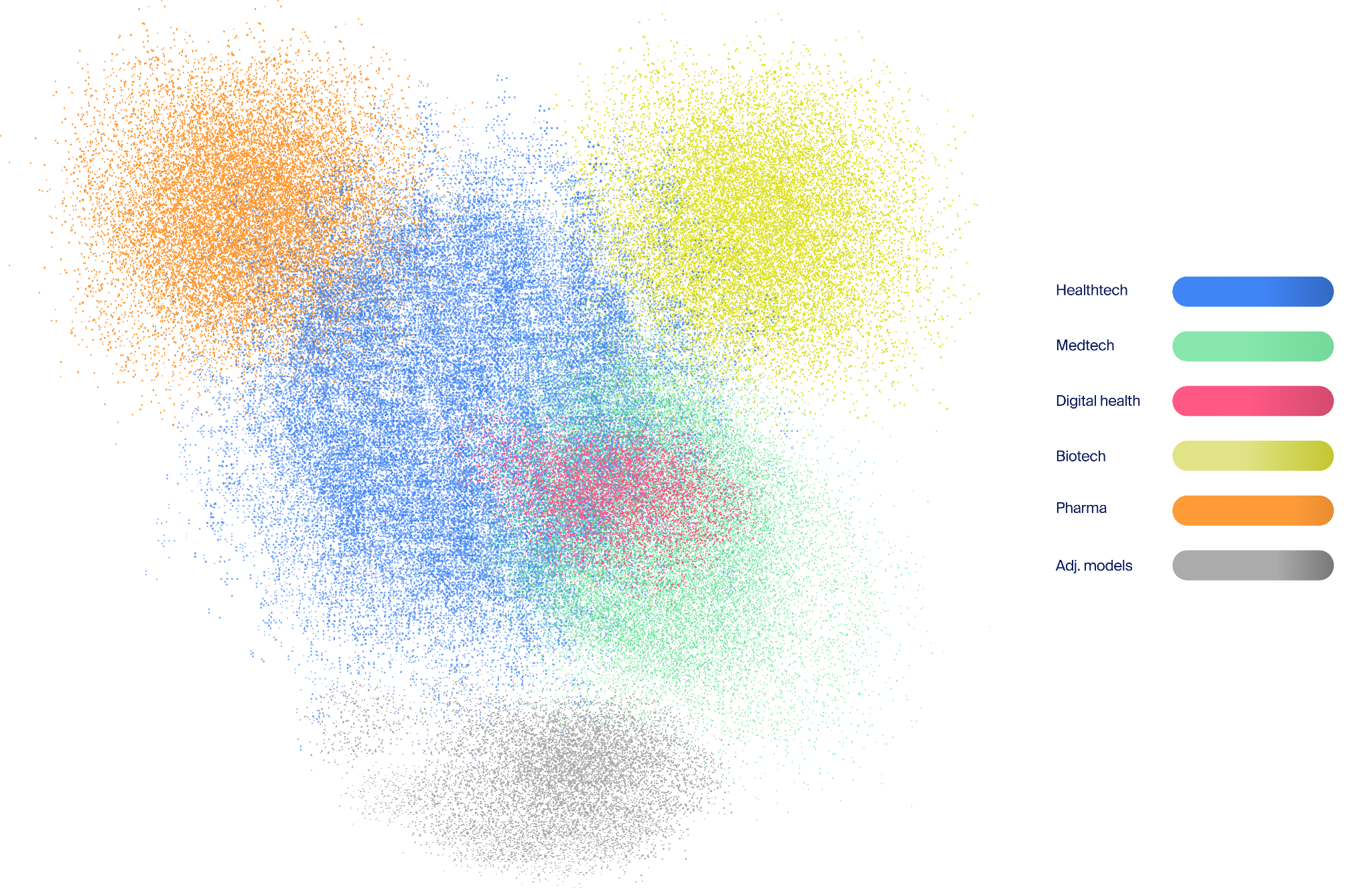
So, where should we start? We wanted to find a structure that could reflect our investment logic, and our primary organising principle is who the technology ultimately serves. The most direct answer to that question is the patient, which is why we place Healthtech at the centre of the map. Healthtech is built around a direct interface with the patient and puts them at the other end of the product, not the institution. For us it is the largest and most important segment precisely because of that: everything in health ultimately exists to serve the patient.
The other segments do not reach the patient directly, but they all do so indirectly. That is why we see the segments in health as interwoven rather than separate, with Healthtech in the middle, framing and to some extent encompassing the rest.
- Medtech is built around healthcare infrastructure and its participants: the clinician, the radiologist, the surgical team, and the underlying frame of administration and management. That distinction matters because it determines the sales motion, the regulatory path, the defensibility logic, and the pace of growth.
- Biotech and pharma are entangled but, for us, far from the core of healthtech. Biotech is at the base: basic science, long timelines, binary outcomes… furthest upstream from the patient. Pharma, in our framing, refers less to the drugmakers than to the pipeline tooling around them: the software, data infrastructure, and analytical platforms (such as MiLaboratories) that pharma and biotech R&D teams depend on.

- Adjacent models (workforce health, insurance) operate on behalf of the broader ecosystem. They are the furthest from clinical infrastructure, but also sometimes easier for us to underwrite, the models look more like the B2B software businesses we back everywhere else. A good example of this is our portfolio company Livo.

- Cutting across Medtech and Healthtech is Digital Health, a category that has grown large enough to stand on its own, but which we still see primarily as the enabling layer reshaping how both segments are built, distributed, and defended. Much of it is consumer-centric, bringing care directly to the patient through software. It is the reason software-native approaches are now viable in parts of the market that were structurally inaccessible to early-stage ventures just five years ago.
Where we focus as a fund is on the intersection of Healthtech and Medtech, not because everything else is less interesting, but because it's where we believe we can actually add value, both in evaluating deals and in supporting the companies we back.
Our position
We've seen companies emerge in this space that have managed to disrupt the market with models and products that have changed the way we relate to medicine. We're now seeing an easily perceptible impact on the physician's daily practice with companies like Abridge and Nabla turning doctor-patient conversations into clinical notes in real time; on the way people understand their own bodies, with Oura, Hilo, or Level Zero tracking different biometrics continuously; and in precision medicine, where breakthroughs like AlphaFold have shown what AI can unlock in biology, and where companies like Owkin or IMU Biosciences are now taking that ambition into clinical practice.

Medicine has changed enormously over the last 5 years, far more than it did over the previous 15. The US has been the primary market capturing this shift, but in Europe there are also highly disruptive companies leveraging this very same technology, and at Kfund we've seen hugely ambitious projects that we've wanted to be part of and support.
We are seeing the European healthcare market develop with spending nearing €2 trillion and with expectations of hitting 12% of OECD GDP by 2040, growing twice as fast as the government's revenues, with 22% of Europeans already over 65. Health has always been a huge market; what's new is that it's finally moving. Europe was the fastest-growing digital health region in the world in 2025 (with total funding up 15% and late-stage deal value up 4.1x), and health systems have started pulling innovation in rather than waiting for startups to push it. Demand is now coming from inside the building.
But the part that excites us most is the companies. A cohort that five years ago was too early, too slow, or too tied to one hospital pilot now shows real retention, expansion, and regulatory defensibility, making health legible as a venture asset class. Not because the problems got bigger, but because the tools (AI, interoperability, frameworks like the EHDS) caught up with the ambition.
The question for a VC firm like us is not whether health is a generational opportunity. It is where within health the returns fit with the VC model, the timelines are investable, and our pattern recognition is real. That question matters even more in Europe, where healthcare systems have historically been slower than the US to adopt new technologies.
For us, the answer is Medtech and Healthtech, and that's where our portfolio has consistently gravitated, plus, where we have the team depth to evaluate opportunities with the seriousness they demand. Biotech and pharma's decade-long development cycles sit outside our model. But Medtech and Healthtech, particularly when built software-native, can compound like the best B2B SaaS while operating in a market with structural tailwinds, genuine defensibility, and buyers facing operational rather than discretionary pain.
Now, we are drawn to markets where the hard part is the credibility, the integration, or the clinical evidence that takes years to earn, this is part of the reason we invested in Hilo back in March 2025, when they already had 20+ years of know-how and an exponentially growing proprietary dataset of 11B+ BP recordings. In health, that friction is not a bug in the system. It is the system. Regulation slows everyone down but that’s precisely why we like it. Once a company clears the regulatory pathway, it’s much harder for the next startup to catch up and we read this as the moat. The bet only fails if the regime itself changes.

In Medtech and Healthtech specifically, that dynamic is most legible. Because the companies that have crossed the regulatory bar are able to embed themselves in the infrastructure of the system and build proprietary data advantages that are difficult to displace. When they manage to do that, they have earned something irreplicable, forcing the market to adapt around them rather than the other way around.
The risk we watch most closely is the one our own thesis creates: if AI keeps letting a latecomer match an incumbent's data advantage, the head start we value gets shorter. So we look for the company's AI can't shortcut, where the advantage isn't only data but clinical complexity earned over years. That intersection, deep clinical complexity meeting scalable technology, is where the head start holds.
A more granular perspective
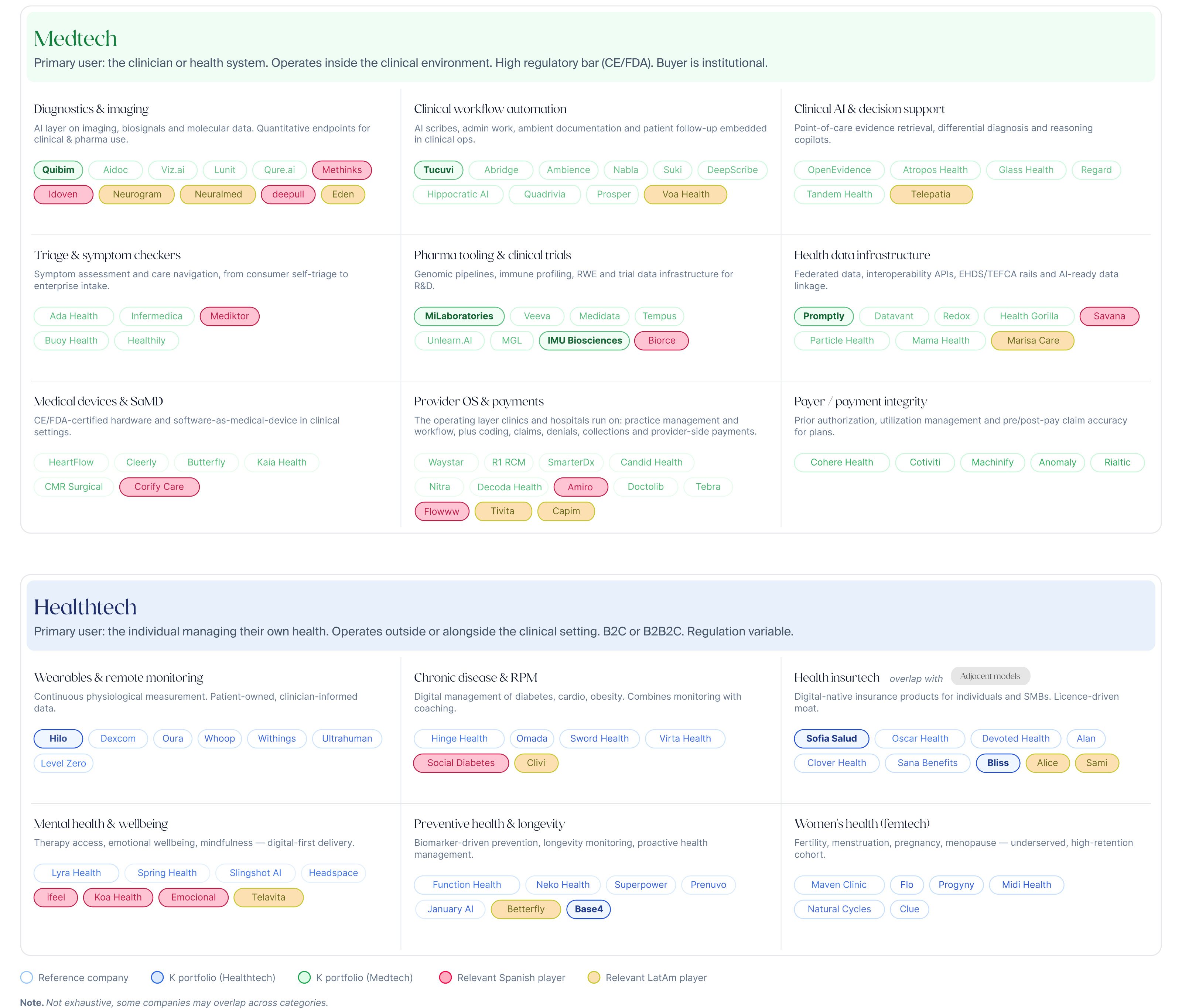
The health startup ecosystem has matured significantly since the previous cycle. What is being built today is categorically different: fewer features, more infrastructure; less convenience, more necessity. As we mentioned before, we believe that the limits between categories are very blurry, but we still wanted to make an attempt at organizing the landscape, even knowing that many of the companies you will see below overlap with other segments and categories. The previous conceptual map shows all five segments; the market map below zooms into the two where we mostly deploy, Medtech and pure Healthtech.
As we framed earlier, everything here sits under one lens: health technology in service of the patient, and the map simply splits that field by how the product gets there. Medtech reaches the patient through the institution: the clinician, the hospital, the administrative layer it embeds in. What we label Healthtech is the part that reaches the patient directly, with the individual at the other end of the product. Every Medtech company shares that same end, it just travels through the system to deliver it, which is why we treat patient-direct Healthtech as the centre the other segments orbit. The market map below is the granular expression of that split:
Within Medtech, three sub-segments stand out as structurally attractive from an early-stage venture perspective.
AI diagnostics: The regulatory bar is super high for new entrants, the clinical evidence required takes years to accumulate, and the data compounds with every case processed. This creates a huge moat vs any other competitor arriving late. The most interesting players here are not building AI on top of existing reads; they are replacing subjective interpretation with quantifiable, reproducible endpoints that pharma and hospital systems will pay for at scale. Our portfolio company Quibim sits in this segment.

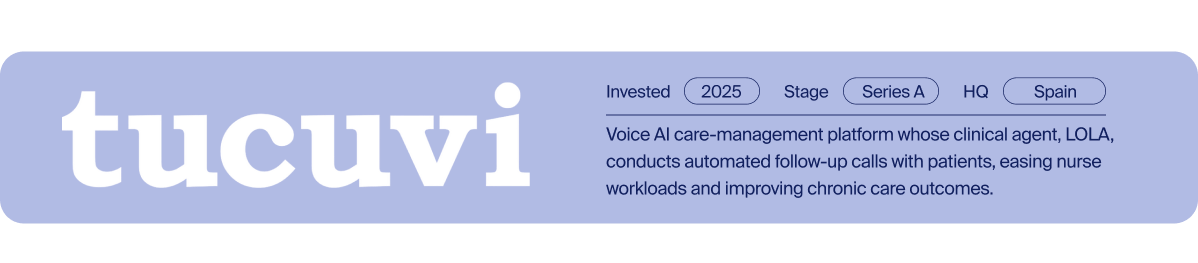
Clinical workflow automation: Ambient AI, voice-driven patient follow-up, and triage tools are being deployed at a pace the sector has never seen, driven by workforce shortages that cannot be solved by hiring. The winners are those embedded deep enough in EHR infrastructure that displacement requires a procurement decision, not just a product switch. A good example of this is our portfolio company Tucuvi.
Health data infrastructure: Federated data and interoperability platforms being built in anticipation of the EHDS, like our portfolio company Promptly, are establishing architectural positions that will take years for competitors to replicate. Being first here is not only a timing advantage, it is a compliance advantage.

On the Healthtech side, the dynamics shift, but the opportunity is equally compelling.\
Wearables and remote monitoring have crossed the threshold from consumer novelty to clinical tool. The clearest proof is continuous glucose monitoring: once a niche device, the CGM is now standard for diabetics. That same model (continuous physiological measurement generating longitudinal datasets) is replicable across other conditions and monitoring needs. The most defensible players are those where clinical validation and hardware are inseparable**.** As previously mentioned, Hilo is our bet in this space, tackling hypertension.
Chronic disease management and RPM are being quietly reshaped by GLP-1s and the rising burden of hypertension. Tens of millions of new GLP-1 users will need adherence infrastructure, comorbidity monitoring, and behavioural support. Hypertension is a second, larger wave: it is one of the most common chronic conditions, it usually travels alongside metabolic disease, and patients now expect to track and manage it from home rather than only in the clinic. Both trends push demand from the provider toward the patient.
Health insurtech is a segment we find underappreciated, and the clearest example of an adjacent model that is quite compatible with the VC model: where regulation creates a genuine licence-driven moat and the incumbent product is broken, the window to build a durable franchise is real. In markets such as Mexico, where brokers and incumbents had systematically ignored a segment of the population, we see examples like Sofía Salud serving the SMB segment.

Preventive health and longevity has become far more interesting for us over the last few years. Our perspective has shifted because we are seeing demand in the segment truly accelerate, such is the case of Neko Health, as people become far more inclined to look after their health, prevent disease before it appears, and keep their bodies measured and under control on an ongoing basis. An example in our portfolio is Base4.

Our Diagnosis
We started without a formulated thesis and ended up with a pattern that points to one. The investments we made on instinct turned out to point roughly in the same direction: between Medtech and Healthtech, the work that takes years to earn (the certification, the dataset, the place inside a clinical workflow) is exactly what makes a company impossible to copy once it exists. The friction we used to treat as a reason to wait is now why these businesses, once built, are so hard to displace. That inversion is the whole point. It is why we can now say with conviction that health has become a space where we want to be more present.
Saying where we stand and how we see the sector is the easy part. The harder, more useful question is forward-looking and that's the one we have learned to respect most, because across this portfolio the binding constraint has never been the science, but the commercial execution that turns a defensible product into a venture-grade company. That is the thread we will pick up in our next post of the series: which trends do we believe and which do we doubt, and where do we think healthcare is heading?
We want to find the people building in this space and we'd love to hear from anyone working in these companies, or who reads the market differently than we do. The thesis above is a starting point, not a closed position, and the best version of it will be shaped by the people actually building this future. Reach out to the team at paula@kfund.vc or cesar@kfund.vc.